In this era of fast-developing technologies, the subtle but powerful role of sound in assessing biodiversity is often overlooked. Bioacoustics, the study of biological sounds in their natural environment, has emerged as valuable toolset for measuring biodiversity.
Bioacoustics involves the detection and measurement of species and soundscapes by collecting the sounds of animals and insects on land or life in waterways. By analyzing these bioacoustic recordings, researchers can gain valuable insights into biodiversity.
For instance, the soundscape of a forest is an elaborate tapestry of sounds. It can range from simple and sparse to vibrant and complex. This diversity in the forest’s acoustic environment can be evaluated to assess its health and biodiversity. A bioacoustically complex or diverse soundscape is often an indicator of high biodiversity and a healthy ecosystem.
Why use acoustic monitoring
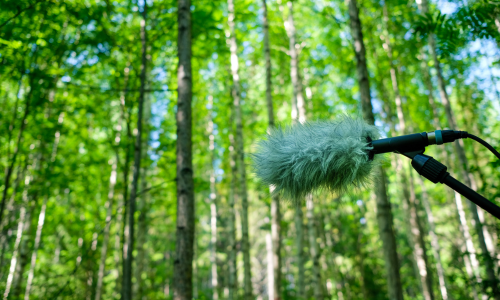
Automated recorders have several advantages over sending ecologists out to repeatedly monitor a site. They can record over a longer period either by taking a constant recording, recording at specific times, or recording in response to a sound. They are less sensitive to positioning than camera traps as they record sound coming from all directions and are less impacted by obscuring objects than visual recorders. The data in them is stored permanently for playback, unlike with a human recorder who must rely on memory and good hearing.
Automated acoustic recorders can also make use of sophisticated software algorithms, which are used in bioacoustic monitoring to capture, process, and analyse these sounds. AI and machine learning approaches are enabling us to pick out sounds from a noisy environment or identify species with more consistency than a human listener.
In fact, these advanced acoustic approaches are showing that sperm whale vocalizations, which include groups of clicks or codas, are much more complex than previously thought.
This approach allows researchers to extract critical data related to biodiversity without disturbing the natural habitat or altering the ecosystem.
Applications
Bioacoustics isn’t confined solely to research. It finds practical applications in areas where field ecologists can use it as a tool for environmental monitoring and assessment. Analysis of bioacoustic data can aid in the identification and monitoring of distinct species. It provides an efficient means to track and understand changes in biodiversity across habitats.
Bioacoustic technology has shown immense potential, not only in assessing the current state of ecosystems but also in creating an auditory archive of natural environments. These audio recordings serve as valuable resources for future generations, allowing them to understand and appreciate the evolution of acoustic communities over time.
Despite challenges such as ambient noise pollution and decoding complex acoustic patterns, ongoing advancements in technology and methodology continue to enhance the accuracy and reliability of bioacoustics for biodiversity measurement and management.
In essence, bioacoustics supports biodiversity measurement and the understanding and preservation of biodiversity. Its unique perspective on the intricate connections within ecosystems enables more informed biodiversity management decisions.
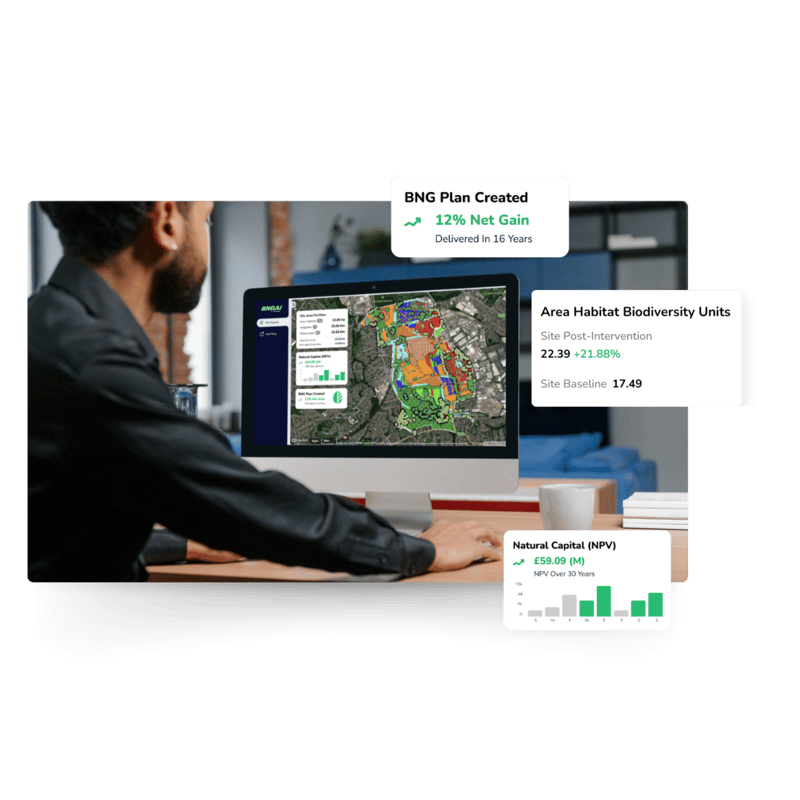
Continue your deep dive into biodiversity measurement here, or learn how AiDash makes it easy to measure biodiversity for BNG planning on BNGAI™.
References
- Sueur J., et al. (2019). Acoustic indices for biodiversity assessments: A meta-analysis. Journal of Applied Ecology.
- Towsey M., et al. (2014). Noise pollution in freshwater habitats: what is its effect on invertebrates? Freshwater Biology.
- Villanueva-Rivera L.J., et al. (2011). Sound identification in the presence of increasing acoustic complexity. The Journal of the Acoustical Society of America.
- Farina A., et al. (2014). The Ecoacoustic Codes and Ecological Complexity. Acta Acustica United with Acustica.
- Sugai, Larissa Sayuri Moreira (2018). Using acoustic monitoring to document biodiversity. ScienceDirect. Elsevier. https://www.sciencedirect.com/science/article/abs/pii/S1470160X18309543
- Landon, Vincent (2023). How do you measure biodiversity? Take a listen. Zurich Magazine. https://www.zurich.com/en/media/magazine/2023/how-do-you-measure-biodiversity-take-a-listen
- Begus, G., Sprouse R., Leban A., and Gero S. (2023). Vowels and Dipthongs in Sperm Whales. OSFPreprints, https://osf.io/preprints/osf/285cs