- Affinity Water uses natural capital to measure the benefits and impacts of their operations on the environment.
- Advanced technologies like remote sensing and AI give Affinity Water the scalable tools they need to conduct accurate environmental assessments, bringing them closer to a biodiversity baseline than any open-source dataset.
- This approach reduces costs, enhances efficiency, and provides valuable data for business decisions and regulatory reporting.
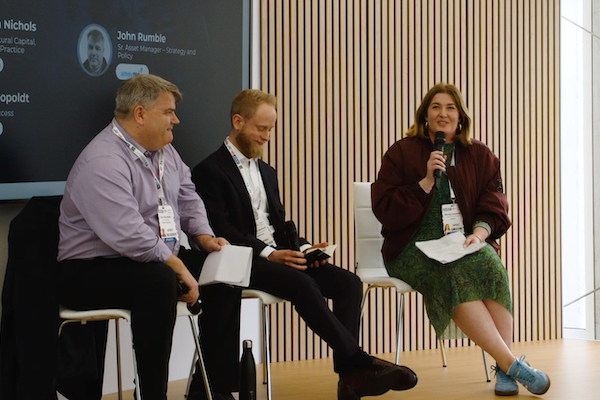
There’s nothing like a real-world success story to help illustrate a complex topic like BNG and natural capital. In a panel discussion at UKREiiF 2024, representatives from Affinity Water, AtkinsRéalis, and AiDash came together to share their experience understanding and measuring biodiveristy and natural capital across Affinity’s many sites, with the goal of efficiently baselining all of them — more than 450.
The project was a challenging one. According to John Rumble, senior asset manager at Affinity Water, quantifying the company’s natural capital was expected to take somewhere between four and six years. But by incorporating advanced technologies like remote sensing, satellite imagery, and a monitoring and management platform, Affinity achieved an accurate picture of their assets in about a year.
Painting a meaningful biodiversity picture starts with understanding natural capital
For Affinity Water, natural capital is a bidirectional benchmark. On one hand, it involves measuring how the environment benefits the company’s operations. Naturally filtered water stored in an aquifer, for instance, confers significant cost savings compared to sources requiring more treatment. On the other hand, natural capital is also used to measure Affinity’s impact on the environment.
“We have to be able to demonstrate that we’ve got overall no deterioration on our sites,” said Rumble. “And we’re building on our sites, so it’s not that simple. But also, then, you’ve got to demonstrate that you’re adding gain, whether that be through the planning process where biodiversity net gain is asking for it, or whether it be through the performance commitment, where we’re committed to actually demonstrating a net increase in biodiversity.”
Cultivating natural capital across Affinity’s 1,600 hectares requires a multifaceted approach. Affinity Water focuses its efforts on biodiversity to ensure that their operations do not detrimentally affect local ecosystems. They also assess their carbon footprint and implement strategies to reduce emissions, contributing to broader climate goals. Water supply — where the water comes from and how much treatment it requires — is critical, of course, as is water quality.
“I’m often saying to our clients . . . that natural assets are assets too, and so natural capital is the framework through which we understand the environment as an asset,” said Jonathan Nichols, an associate at AtkinsRéalis. “For many businesses, including Affinity Water, the environment is essential to the operations and the financial performance and the regulatory performance of that business.” Thus, there’s an economic incentive to accurately quantify the value of the benefit that natural assets provide.
Leveraging technology to measure natural capital
Nichols recounted some of the tools his team needed to consider ahead of the Affinity Water project. The Environment Agency’s Natural Capital Register and Account (NCRAT) tool, for example, offers a Microsoft Excel-based template for inputting data across several tabs to generate output tables and graphics. Defra’s Statutory Biodiversity Metric includes user guides, calculation tools, and methodologies to facilitate compliance with BNG.
In both cases, the core foundation of any natural capital account is understanding what you’re starting with. Often, that involves a desk-based analysis using publicly available open-source information on habitats.
“Because we did need to get down to using the biodiversity metric, where you do have to undertake a ground survey in order to assess the condition of those assets, the open-source information just wasn’t going to get us there in terms of the amount of detail that we required,” said Nichols.
Affinity Water owns a lot of land across a diverse range of sites, though. Surveys just weren’t an option. That took AtkinsRéalis down the path of using remote sensing technology with satellite imagery for habitat classification.
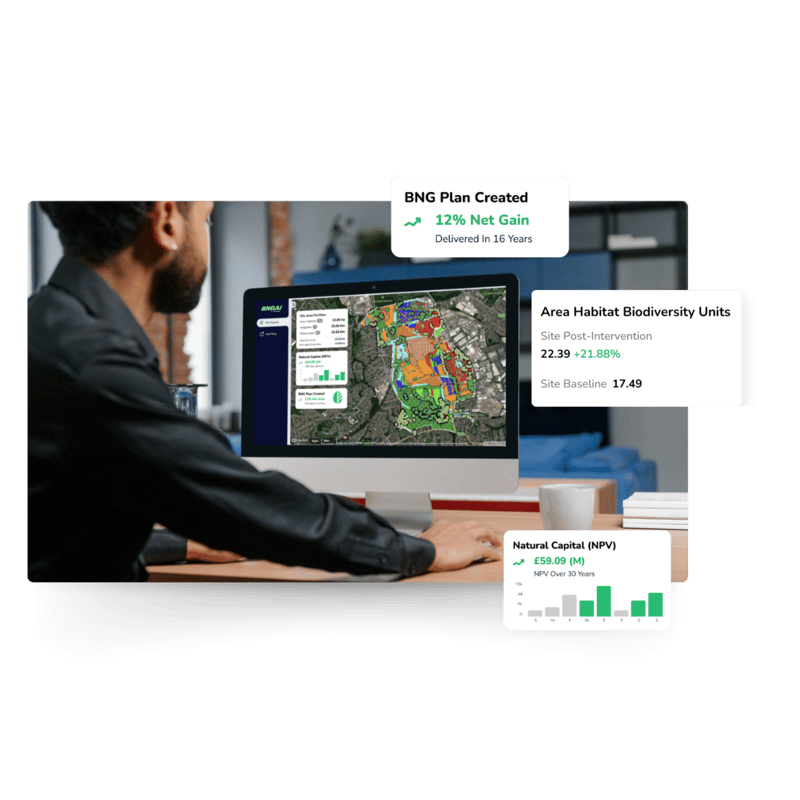
Nichols continued, “Sometimes, when we undertake this kind of analysis for clients, they may have a GIS data set that comes out of that. They get a nice report — a very accessible report. But what this system from AiDash — the BNGAI™ platform — gave us was also a monitoring and management platform, as well as a way to work with Affinity’s in-house ecologist to verify some of that data.”
As a result, Affinity Water saw significant operational and financial benefits. “This project has saved us a lot of time and money, and it gives our ecologists accurate data to work with,” said Rumble.
Beyond minimizing fieldwork that can take years to complete, the insights gleaned from a more accurate natural capital account can lead to better resource allocation. Now, Affinity Water can identify which areas of their operations offer the most significant environmental benefits and prioritize investments accordingly. This targeted approach ensures that funds are used effectively, maximizing both financial returns and environmental gains.
Continued collaboration is key to natural capital accounting
The collaboration between Affinity Water, AtkinsRéalis, and AiDash demonstrates how technology and strategic planning can enhance natural capital measurement and management. “It’s important to understand the inputs to really grasp the outputs. There’s a lot of smart technology involved, but it’s crucial to maintain transparency and collaboration,” Nichols concluded.
Moving forward, continuous improvement and adaptation will be key. Regularly refining the tools and methodologies used for natural capital accounting ensures they remain relevant and effective, even as new regulations move the goalposts.
The success of projects like these also hinges on stakeholder engagement. By involving all relevant parties, from ecologists to financial directors, companies like Affinity Water can ensure that their natural capital strategies are comprehensive and well-supported. This inclusive approach not only enhances the quality of decision-making but also promotes a culture of sustainability within the organization.
Continue your deep dive into biodiversity measurement here, or learn how AiDash makes it easy to measure biodiversity for BNG planning on BNGAI™.